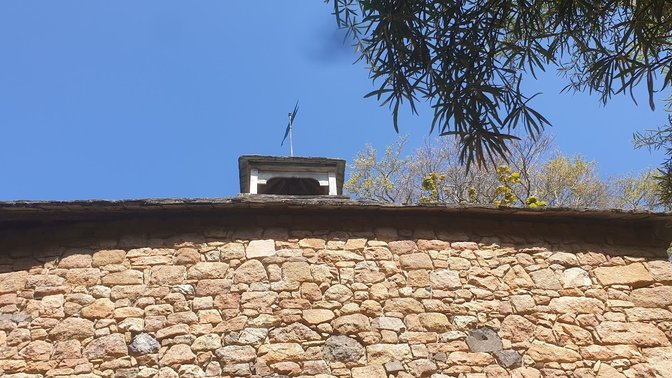
The Hamptonne Colombier (Pigeon House)
Le Chemin des Moulins, Jersey JE2
Rating: 5.0 ★ (2 ratings)
Details
It is a very interesting architecture and a historic building. THE COLOMBIER (DOVECOTE) PIGEON HOUSE The Hamptonne Life Museum The dovecote, or colombier, is a small square building, dated 1674, which stands well apart from the main complex of buildings at Hamptonne, being separated by the small valley-head and Le Chemin des Moulins that lies immediately to the south of the farm. The colombier was repaired and restored in the 1990s, including reinstatement of the pyramidal oak roof, incorporating a simple cupola, covered with reclaimed French slates and crowned by a wrought iron vane. The colombier measures 5.9m square overall and its walls stand to a height of 5.0m above the foundation offset. The walls are consistently built of small, mixed rubble, laid in loess mortar with no evidence for the use of lime. The masonry mainly comprises granite, although there is much use of shale in small pieces, some French slate for levelling, occasional lumps of quartz and one piece of French millstone. The quoins are made of blocks of hammer-dressed Mont Mado granite of varying sizes, laid in side-alternate fashion. A single block, in the north-west quoin, exhibits quarry wedge-marks, and one
THE COLOMBIER (DOVECOTE)
PIGEON HOUSE
The Hamptonne Life Museum
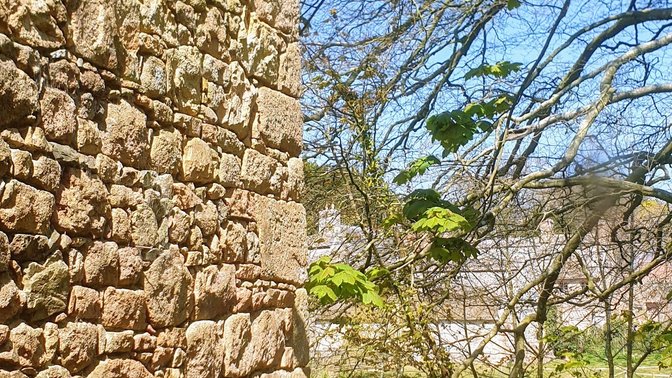
The dovecote, or colombier, is a small square building, dated 1674, which stands well apart from the main complex of buildings at Hamptonne, being separated by the small valley-head and Le Chemin des Moulins
that lies immediately to the south of the farm.
The colombier was repaired and restored in the 1990s, including reinstatement of the pyramidal oak roof, incorporating a simple cupola, covered with reclaimed French slates and crowned by a wrought iron vane.
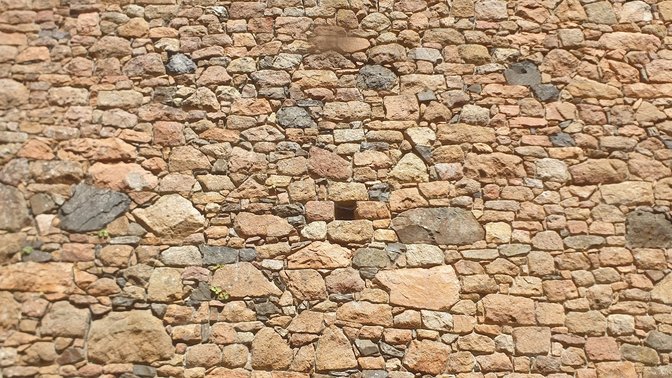
The colombier measures 5.9m square overall and its walls stand to a height of 5.0m above the foundation offset. The walls are consistently built of small, mixed rubble, laid in loess mortar with no evidence for the use of lime. The masonry mainly comprises granite,
although there is much use of shale in small pieces, some French slate for levelling, occasional lumps of quartz and one piece of French millstone. The quoins are made of blocks of hammer-dressed Mont Mado
granite of varying sizes, laid in side-alternate fashion. A single block, in the north-west quoin, exhibits quarry wedge-marks, and one re-used in the north-east quoin bears the eroded remains of some initials. A few other blocks are reused from elsewhere, including four stones taken from window surrounds with pockets for ferramenta. The walls are constructed as two skins, with an infill of small rubble between them. The nesting holes for the pigeons were built as part of the internal skin. The masonry of the colombier is
of a single build, and embodies only one architectural feature: the doorway.
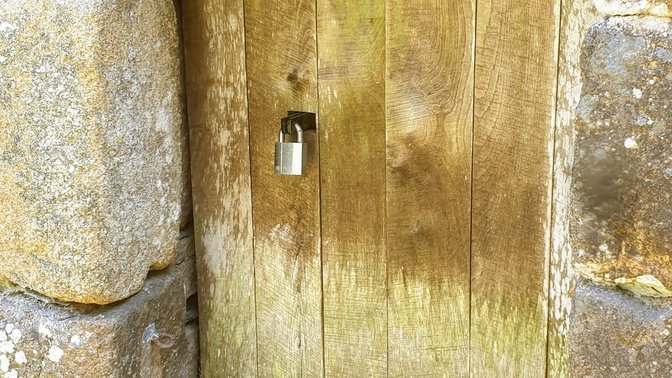
The entrance is on the west side. It comprises a low, square-cut doorway with three unchamfered granite blocks in each jamb, the first being an upright stone. The jambs stand on a granite threshold slab, and they supported a granite lintel – a re-used head of a domestic window, with chamfered arrises and two pockets for iron stanchions in its soffit face. There is an internal rebate all round the opening, including at the threshold (to ensure a vermin-proof seal). The lintel
is surmounted by a weathered datestone in the form of a square plaque. The block of Mont Mado granite is built into the wall, flush with its face, and carries a three-line inscription set within a framework of incised lines. It reads: I.A. E.H. 1674, the initials referring to Josué Ahier and Elizabeth Hamptonne. The interior
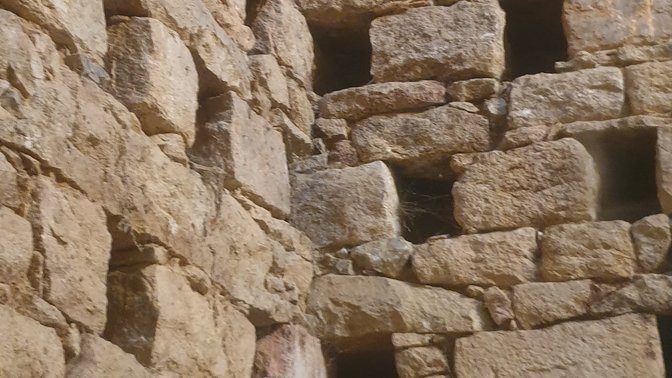
is a single, undivided space, open from floor to roof. Internally, the structure of the walling is regimentally coursed, incorporating twelve rows of nesting places: each is L-shaped in plan. There is a total of 407 nesting places. The floor is loess.
#Jersey #jersey_heritage